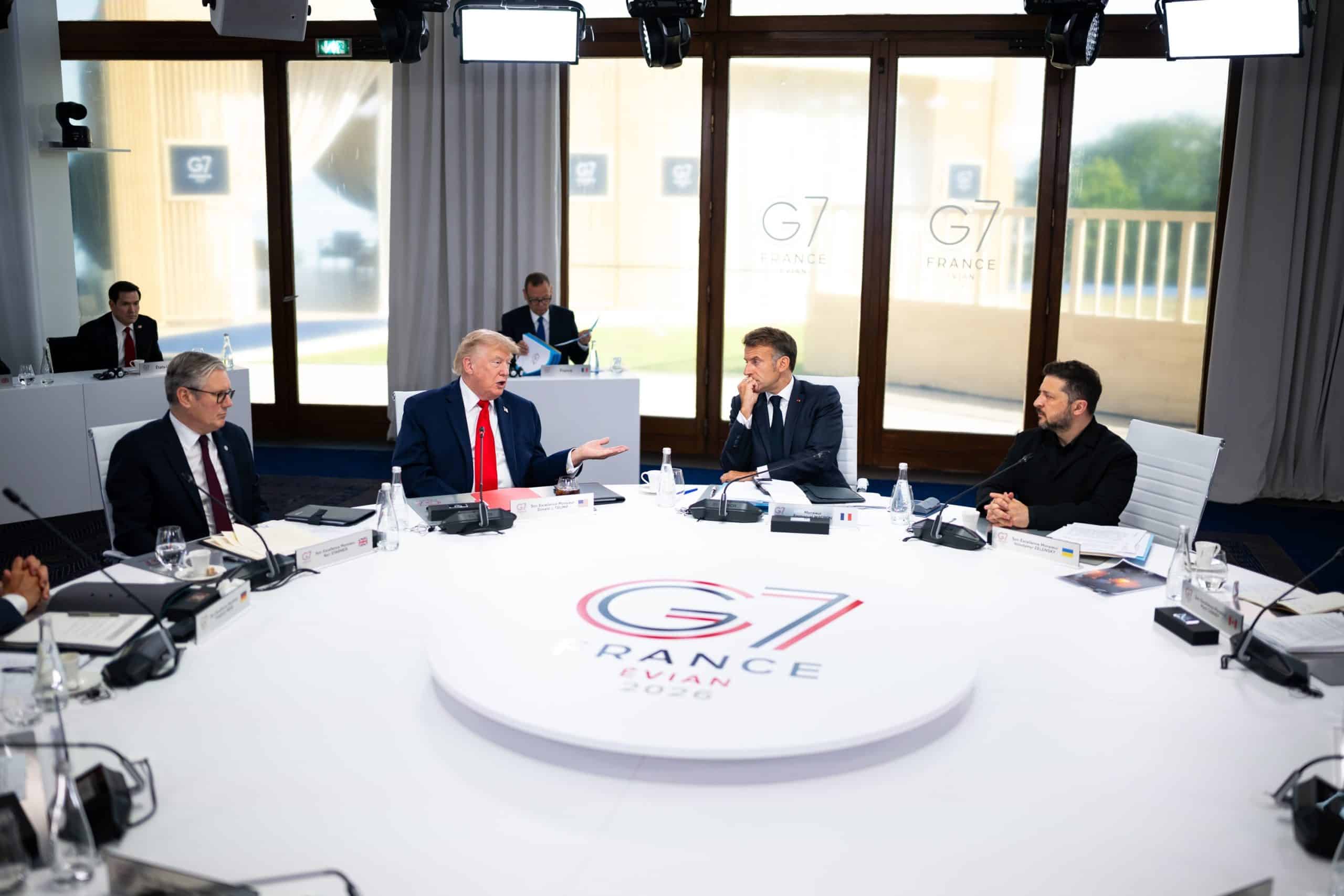
As the U.S. begins to strategize its second step for disengagement from the Middle East, following its September 30 withdrawal from Iraq and Syria, regional powers are realigning and preparing to share defensive commitments. In the shadow of the U.S.’ military footprint, a new security alliance has emerged between Saudi Arabia, Türkiye, and Pakistan: the Mecca Pact, a NATO-like alliance with a mutual defense clause, designed to stave against adverse regional powers and share security burdens.
The pact has become a key force in a changing Middle Eastern geopolitical landscape, with a plan to expand and take on more members. Late last month, the prospect of Syrian membership was floated amongst policymakers, with Syrian Foreign Minister Asaad al-Shaibani signaling interest in the building alliance.
The prospect of Syria’s inclusion in the Mecca Pact reflects several factors. Firstly, a growing interest for a new security architecture and to prevent encroachment from regional adversaries like Iran and Israel, as Washington, readjusts its military posture and recedes from the region. Secondly, to prevent Syria—once a playground for foreign interventionism during its civil war—from once again becoming a hub for influence projection and instability. And thirdly, the Mecca Pact’s leadership seeks to expand its membership as a defense mechanism against a potential peer threat in the region: Israel. By picking up members that have been the frontlines of Israeli territorial encroachment like Syria, Jordan, and, potentially, Lebanon, the Mecca Pact mutual defense clause could serve as a factor for deterrence against a push by Israel into contested areas in the Levant.
It is clear that what was initially a Saudi-Turkish-Pakistani framework for cooperation amidst an uncertain U.S.-Iran war has become the basis for a broader regional security arrangement—setting the groundwork for what the ‘day after’ U.S. military disengagement from the region could look like. The Mecca Pact’s design and nature not only accounts for an absent United States, but also the likelihood that Iran and its proxy network could very well still pose a threat to regional security, along with the continued risk of Israel posing an additional threat of escalation against regional actors.
Syria’s potential membership would represent a major change to the Mecca Pact’s design, dynamics, and geopolitical implications. Given the fact that Israel is already engaged in a periodic strike campaign and territorial encroachment into Syria, focused on the Golan and the country’s south, Damascus’ entry into the pact would carry immediate implications. Israel is committed to ensuring Syria remain a buffer zone with relative instability to ensure it can exploit the security environment, as was the case with the Assad regime era. Tel Aviv would have a hard time accepting a more capable, defensible Syria supported under a multilateral umbrella of regional rivals — particularly Türkiye, which it has already sought to stave against with strikes against perceived sites of Turkish military activity. For Saudi Arabia, Türkiye, and Pakistan, admitting Syria as a member would increase the risk of escalation — even direct conflict — with Israel, challenging the pact’s collective-defense clause. It is possible that if Syria were accepted, Israel would test the validity of the collective defense clause early through Syria, given its existing posture in the Golan and influence amongst actors like Druze militias, gauging whether regional actors are willing to expend political capital and accept the risk of direct confrontation. While the Pact’s founding members may have a strong interest to bolster regional deterrence, some may have little interest in being pulled into an open-ended military confrontation with Israel that could undermine plans to bolster regional stability and deescalation after the U.S.-Iran and Gaza war.
Furthermore, a rushed entry of Syria into the Mecca Pact would represent a missed opportunity for the Mecca Pact’s members, along with regional partners, to set clear conditions and expectations. While Syria’s strategic position represents a major ‘gain’ for the Pact geographically, the country’s relative weakness after over 13 years of civil war, leaves great room for capacity-building and improvement in Syria’s defensive readiness. If the Pact’s defense clause was ever activated in the near-future, there is a question of what Damascus could bring to the table—two years after the fall of Assad, Syria’s armed forces are still restructuring, absorbing former rival militias, and establishing a new structure for command and control.
Syria’s entry into the Mecca Pact would also challenge its current foreign policy trajectory and represent a strategic dilemma in its leadership. Since the Assad regime fled, the new administration has run its Foreign Ministry with a ‘zero problems’ policy that has been to avoid excessive dependence on any single external sponsor, avoiding entry into conflicts and foreign wars, and build a pragmatic foreign policy strategy that focuses on domestic financial recovery first and foremost. The prospect of Syria entering into any formal regional alliance — particularly one based on a mutual defense clause — could represent a departure from the government’s initial plan, aligning explicitly with a particular regional bloc instead of diversifying relations across competing regional factions. It is true that Syria joined a formal coalition in November 2025, when the U.S. invited Damascus to become a member of the Coalition to Defeat the Islamic State of Iraq and Syria (ISIS). However, with the complete withdrawal of the U.S. from Iraq and Syria in September 2026 and the dissolution of the Operation Inherent Resolve Mission, the Coalition to Defeat ISIS has considerably diminished as a framework, already giving way to bilateral memorandum of understandings and informal partnerships to defeat terrorist threats. Joining the Mecca Pact would represent a far more consequential decision for Damascus, given its collective-defense provisions and alignment with key regional actors like Saudi Arabia, Türkiye, and Pakistan.
As the idea of Syria’s Pact membership has been floated, the country’s ‘zero problems’ foreign policy approach has been put to the test amidst signals of greater alignment with Saudi Arabia. Following Syrian President al-Sharaa’s visit to Riyadh that resulted in a military cooperation agreement, the Associated Press and several other outlets reported that Syria had dispatched delegation of Syrian officers to a joint command center in Jeddah to prepare deploying hundreds of special forces and advisory support from the Syrian Army to help Saudi Arabia stave off the ongoing Houthi offensive. While Foreign Minister Shaibani has publicly denied any plans or ongoing efforts were in place to assist Saudi Arabia, Syria’s strong security alignment with the Kingdom called into question elements of its ‘zero problems’ strategy.
These realities collectively contribute to the likely reality that Syria’s entry into the Pact is unlikely to materialize in the immediate term. Furthermore, there is the prospect of the Mecca Pact failing to deliver an effective model of collective security in the first place, particularly as the Iran war continues to unfold and questions continue to arise regarding the Pact sponsors’ security commitments. The Mecca Pact’s design is still in flux, with no defined thresholds for what would trigger the collective security clause, which regional actor(s) the Pact seeks to deter, and rules of engagement in the face of an attack.Within the alliance, there exists misalignment and divergence over perceived security threats and targets that could deter the Pact from serving as an effective model of collective security. While the Pact’s founding members have converged on deeming Iran as a regional security risk, additional security priorities such as Saudi Arabia’s against the Houthis in Yemen, Pakistan’s against India in Kashmir, and Türkiye’s against Kurdish militants in northern Syria and Iraq, could very well create sharp political divide and internal friction over the scale and scope of the Pact. Furthermore, there are questions about the nature of support in the face of the collective defense clause. If a member is attacked but its fellow Pact members opt for a more cautious, non-escalatory course of response – selecting forms of indirect support like sending air defense systems instead of direct intervention through ground forces – the collective security model will be put under further question. As Doga Eralp wrote for War On The Rocks: there is a serious credibility gap already within the Mecca Pact. This is especially in light of likely friction with Israel, even without Levantine members like Syria or Jordan. But the discourse and prospect of Syria’s entry into the Mecca Pact – let alone the premise of a regional collective security agreement on its own – remain valuable in its own right, prompting regional actors and competitors to think about what a regional security architecture could and should look like after the conclusion of the U.S.-Iran war and inevitable American security disengagement.
There is a ‘middle ground’ option that presents a more likely and pragmatic result for regional actors: an incremental model of Syrian engagement with the Pact. Rather than immediate full membership, the Mecca Pact’s leadership could pursue bilateral or multilateral security arrangements that mirror the more partnerships with non-member countries that collective security organizations like NATO conduct with 35 countries, averting full membership could prompt escalation with major regional rivals. Such an arrangement could provide Syria with the ability to bolster its defense capabilities, such as access to military training, intelligence-sharing, advisory and expert support, combined-arms multilateral exercises, defense planning, and capacity-assistance without applying the Pact’s mutual defense clause that could draw in controversy and escalation with regional rivals like Israel. Syria could gradually bolster its defense capacity and interoperability, while the Pact’s leadership — Saudi Arabia, Türkiye, and Pakistan — could deepen ties with Syria without having to take on the risk of regional escalation early on in the alliance’s trajectory.
In lieu of a mutual defense clause, mutual security cooperation between Syrian security forces and the emerging Mecca Defense Pact could offer a new layer of deterrence in the region, complicating Israel’s strategy against regional rivals and in contested territories across the Levant. Policymakers should take the prospect of Syria’s membership in the Mecca Pact seriously, but one that is likely further down the line. While the strategic incentives are valuable, offering the Pact greater strategic depth and the opportunity to positively influence a postwar transition process, the risks of regional escalation over Syria’s entry remain large. If the Pact proves successful in achieving a collective security model and can enlist more members, policymakers should forecast the potential implications and identify creative solutions, such as incremental non-member partnerships, as a way to establish effective deterrence while building strong security capabilities.