In this OrionTalks episode, hosted by Suat Cubukcu, COL (R) Bill Edwards discusses his new book, The Perimeter Has Changed, and how drones, emerging technologies, and evolving threats are reshaping physical security. An Iraq War veteran and experienced drone and counter-drone professional, Edwards is a recognized thought leader in the
In July 2026, the Trump Administration announced GOLD EAGLE, a new federal clearinghouse with the goal of improving cybersecurity vulnerability coordination, using artificial intelligence (AI) to identify software flaws and speed up the time it takes to fix them. While a commendable and necessary effort, the current public details on
Long before the invention of cyberspace, deterrence guarded the U.S. against attack by promising to retaliate in kind against any nation that struck American territory. The Cold War concept of mutually assured destruction may not have been sophisticated, but it was effective at discouraging nuclear conflict with the United States.
According to data from the Orion Policy Institute’s newly launched Records of Critical Cyber Attacks (ROCCA) Project, China and Russia account for 458 originated cyberattacks, or 48% of the 954 incidents recorded between 2005 and 2025. The United States is the most targeted country, and these attacks have increased sharply
Anthropic’s Mythos/Fable model ban showed Washington acting on a lab signal it could measure while flying blind on the one it can’t. On June 12, the Commerce Department ordered Anthropic to cut off foreign-national access to its two most capable models, Fable 5 and Mythos 5. The reason, according to
Introduction Between September 1986 and June 1987, a group of German hackers conducted the first recorded act of cyber espionage, breaching US civil and military organizations and selling stolen data to the Soviet KGB. Since then, cyber espionage has become an evolving threat and state-sponsored campaigns targeting sensitive government and
AI has become a buzzword in the tech world, often incorporated into many new products or services – even into things you would not expect, such as toasters and toothbrushes. It has the potential to enhance human knowledge, advance technology, and contribute to building a brighter future. However, it is
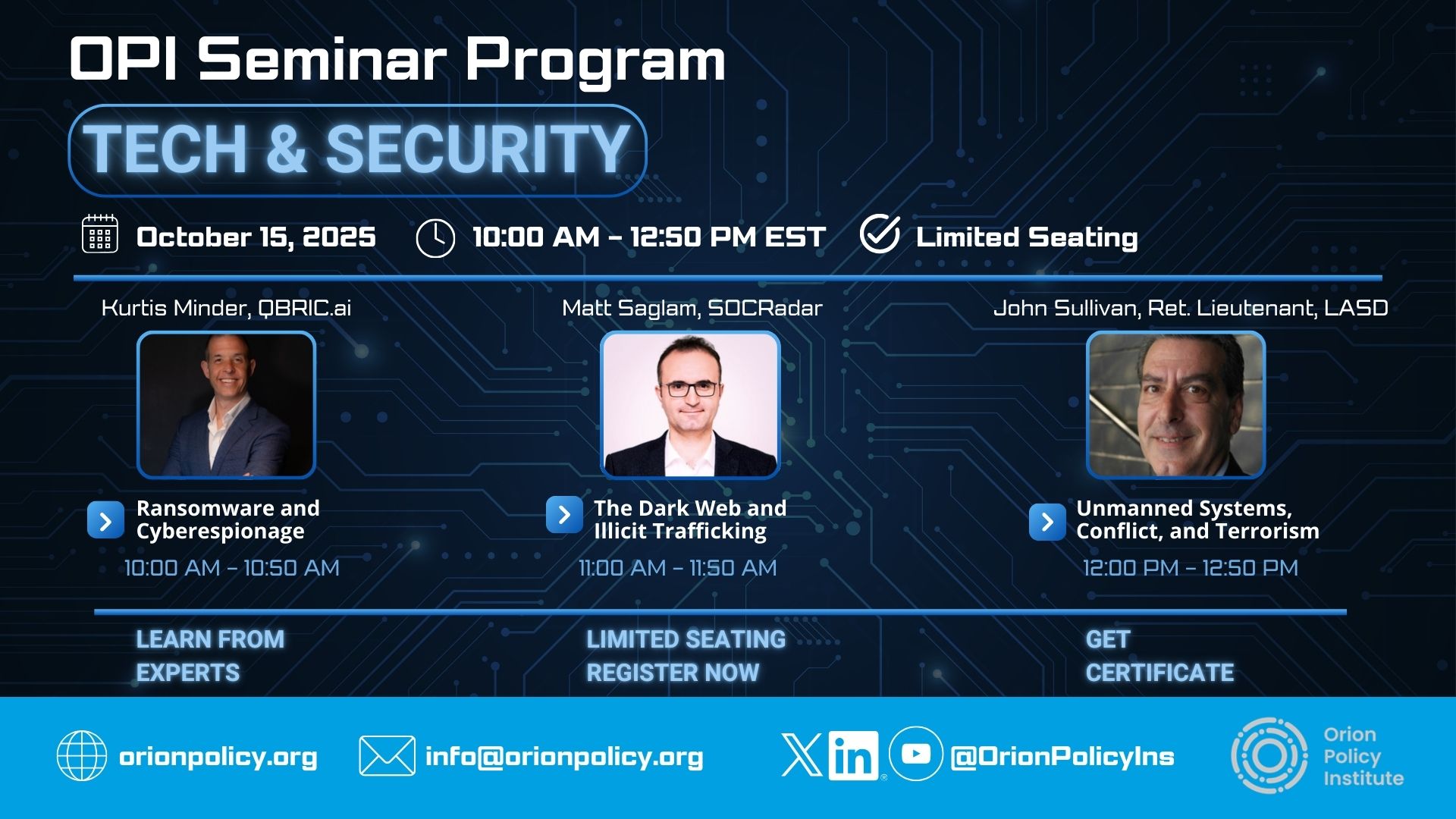
Orion Policy Institute (OPI) hosted an online seminar program on Wednesday, October 15, 2025, between 10 am – 12:50 pm EST to discuss the latest trends and strategies shaping the modern landscape of technology and international security. The seminar schedule was as follows: 10:00 am – 10:50 am EST >
ATM and POS skimming is a recurring societal problem, especially with the changing technological world. Recently, police discovered ATM skimming devices at convenience stores in York County and Lancaster County[1]. In Philadelphia, Supplemental Nutrition Assistance Program (SNAP) benefits were compromised due to skimming devices[2]. Although these are three macro-level events,
The past year stands out as one in which cyber adversaries have notably increased their operational capabilities. Cybersecurity in 2024 has been marked by the impact of AI, political and military conflicts in cyberspace, and compromised supply chains. Furthermore, nation-state actors have become more aggressive in cyberespionage campaigns, and Advanced
The rapid escalation of cyber attacks on critical infrastructure highlights an urgent need for a comprehensive approach to cybersecurity, reminiscent of the civil defense strategies developed during and after World War II. In response to the growing threats in cyberspace, the concept of Cyber Civil Defense has emerged, advocating a
Despite significant investments in cybersecurity infrastructure and new technologies, cyber threats are still rising. Several hacking incidents, such as the MOVEit, 23andMe, and MGM Resorts hacks, marked the year 2023. We also saw the launch of the Biden-Harris administration’s National Cybersecurity Strategy and the National Cyber Workforce and Education Strategy