|
Country of Origin |
China |
| Threat Actor Type | State-sponsored cyber espionage group |
| Other Names | Winnti, Barium, Blackfly, Wicked Panda, and Double Dragon |
| Year Identified | 2012 |
| Target Countries | United States, Canada, United Kingdom, Japan, South Korea, Singapore, Saudi Arabia, Mexico, and other countries worldwide. |
Profile Summary
APT41, also known as Winnti, Barium, Blackfly, Wicked Panda, and Double Dragon, is a Chinese-linked hacking group that carries out both government-backed espionage and cybercrime for financial gain. It is widely tracked in public threat intelligence frameworks, including MITRE ATT&CK. The actor has been active since at least 2012 and remains operational. The group is often assessed to be associated with Chinese state interests and is often linked to Ministry of State Security (MSS)-aligned activity, although the exact command structure is not publicly confirmed. Its dual-use operational model, combining intelligence collection with criminal financial gain, distinguishes it from many other APT groups. APT41 primarily targets government, defense, technology, telecommunications, and healthcare sectors worldwide. Its common techniques include spear phishing, exploitation of public-facing applications, supply-chain compromise, credential theft, custom malware deployment, and covert command-and-control infrastructure leveraging legitimate cloud services. From a policy perspective, APT41 is significant because it simultaneously threatens national security systems, economic competitiveness, and critical infrastructure across multiple regions.
Background & Development
APT41, also known as Winnti, Barium, Blackfly, Wicked Panda, and Double Dragon, emerged in China in 2012, with early operational activity often associated with Chengdu, Sichuan. From the outset, it was unusual among APT groups due to its blended mission set: combining espionage operations with financially motivated cybercrime. Over time, the group expanded beyond early activity focused on gaming ecosystems and digital asset theft into broader intelligence collection campaigns. These later operations increasingly targeted government, defense, healthcare, telecommunications, and technology sectors. Its operational sophistication also increased, incorporating supply-chain compromises, exploitation of newly disclosed vulnerabilities, custom malware frameworks, and stealthy C2 mechanisms that include abuse of legitimate cloud services. APT41 has repeatedly exploited high-profile vulnerabilities, including CVE-2019-19781 (Citrix ADC), CVE-2020-0688 (Microsoft Exchange), and CVE-2021-22893 (Pulse Secure VPN), allowing operators to quickly compromise enterprise environments before organizations could fully patch affected systems.
Two developments were particularly influential in shaping how APT41 came to be understood by policymakers, security practitioners, and the broader public. The first was the series of U.S. Department of Justice indictments issued in 2019 and 2020, which publicly named individuals linked to APT41 and detailed years of intrusions targeting organizations across multiple sectors and countries. The 2020 indictment identified alleged APT41 members Zhang Haoran, Tan Dailin, Zhou Shuo, Wang Zheng, and Wu Shurong. These cases provided an unusually detailed view into the group’s operations, infrastructure, and alleged ties to Chinese state interests. The second was the accumulation of technical reporting from cybersecurity firms (most notably from Mandiant), which consistently documented APT41’s unusual combination of state-aligned espionage and financially motivated cybercrime. Activity observed since 2021 suggests that these core operational characteristics have remained intact. Rather than indicating a decline in activity, subsequent campaigns (seen in the table below) have shown continued targeting of enterprise environments alongside ongoing refinements to malware tools, operational security practices, and command-and-control infrastructure.
Organizational Structure
APT41 is assessed to operate as a decentralized, functionally specialized network that periodically aligns with state-directed objectives. Reporting indicates a hybrid model in which semi-autonomous teams conduct parallel operations while drawing on shared infrastructure and tooling, consistent with China’s broader cyber ecosystem. Its structure has evolved from early-2010s espionage-focused activity to a dual-use model by the mid-to-late 2010s, combining state-linked intelligence collection with financially motivated cybercrime. Although the group’s internal hierarchy is not publicly known, open-source reporting suggests that APT41 operates through a contractor-based model in which commercially affiliated personnel support state-directed operations while retaining the flexibility to conduct independent financially motivated campaigns. This model reflects the broader Chinese cyber ecosystem, where private companies, research institutions, and government security services frequently overlap.
Available reporting suggests APT41 likely consists of specialized units including strategic planners and intelligence collectors, malware developers and tool engineers, initial access operators, infrastructure and command-and-control managers, and financial operators conducting ransomware and fraud campaigns. This division of labor supports concurrent campaigns and rapid capability reuse. The group demonstrates high-level technical capability, including use of zero-day vulnerabilities, software supply-chain compromises, cloud-based command-and-control, and “living-off-the-land” techniques; however, some financially motivated activity reflects mid-level tradecraft, particularly in opportunistic intrusions.
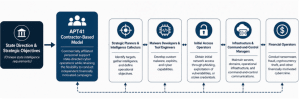
Recruitment patterns suggest APT41 does not rely primarily on open criminal forums but instead draws personnel from China’s state-affiliated technical ecosystem, including private cybersecurity firms, contractors, and university-trained technical talent. U.S. Department of Justice indictments allege that several APT41 operators worked for Chengdu 404 Network Technology Co., Ltd., a company accused of conducting computer intrusion operations on behalf of China’s Ministry of State Security while simultaneously engaging in financially motivated cybercrime. This arrangement illustrates China’s use of commercially affiliated entities as operational cover, enabling access to highly skilled technical personnel while maintaining plausible deniability and flexible, contractor-like relationships between state intelligence services and cyber operators.
State and Non-State Relations & Strategic Objectives
APT41 is widely assessed as state-aligned, with strong but not formally confirmed ties to Chinese government intelligence operations. Politically, the group supports intelligence collection against foreign governments and strategic institutions. This includes surveillance and data theft from political, defense, and diplomatic systems. Multiple government agencies and private cybersecurity firms have assessed that the group maintains operational relationships with China’s Ministry of State Security (MSS), with several reports specifically identifying the Sichuan State Security Department (SSD) as the provincial organization most closely associated with APT41 activity. Militarily and operationally, its activities contribute to long-term access development in sensitive networks, which could be leveraged for future strategic effect. Economically, APT41 engages in both state-aligned intellectual property theft and opportunistic cybercrime. This includes theft of trade secrets, proprietary research, and commercially valuable data, alongside monetization of compromised systems through criminal activity. There is no clear ideological or activist motivation. The group appears pragmatically aligned with state interests, but retains the ability to conduct operations for financial gain.
Target Profile
APT41 demonstrates broad global targeting across government, defense, technology, telecommunications, healthcare, finance, energy, manufacturing, and supply-chain-dependent service providers. Its geographic footprint includes North America, Europe, and Asia. Campaigns have also affected organizations in the Middle East and other regions, reflecting the group’s ability to operate globally wherever strategic or economic opportunities exist. Target selection is typically driven by the amount of information available and the presence of exploitable vulnerabilities. Rather than focusing on a single industry, APT41 consistently prioritizes organizations that possess valuable intellectual property, sensitive government information, or access to downstream customer networks. The group has also shown a strong preference for supply-chain entry points, allowing it to leverage trusted relationships between service providers and downstream clients. This approach enables APT41 to compromise multiple organizations through a single trusted vendor or managed service provider, significantly increasing the scale and efficiency of its operations. APT41 is also notable for its consistent focus on critical infrastructure-adjacent sectors, particularly telecommunications, healthcare, energy, and government systems. This increases both strategic value and systemic risk exposure. Notable victims have included government agencies, defense contractors, multinational corporations, healthcare organizations, telecommunications providers, and video game developers such as Riot Games, Capcom, NCSoft, and Nexon. This broad targeting reflects the group’s dual mission of supporting state intelligence collection while conducting financially motivated cybercrime.
Assessment of Impact
The national security impact of APT41 stems from its sustained targeting of defense, intelligence, and government networks. Economically, the group contributes to significant intellectual property theft, competitive distortion, and financial losses for affected organizations. Its dual-use model amplifies this effect by combining espionage-driven theft with criminal monetization. Cybereason’s investigation into Operation CuckooBees estimated that APT41 exfiltrated hundreds of gigabytes of intellectual property from approximately 30 multinational companies in the manufacturing, energy, and pharmaceutical sectors. Based on the value of the stolen engineering designs, proprietary research, and trade secrets, the firm assessed the theft to represent “trillions” of dollars in intellectual property value, although this estimate reflects the potential economic value of the stolen intellectual property rather than verified direct financial losses.
From a public safety perspective, while APT41 is not primarily a destructive actor, its targeting of healthcare, telecom, and energy-adjacent systems introduces indirect risk to essential services. Even non-destructive access can create systemic vulnerabilities. Although APT41 has generally prioritized espionage over sabotage, long-term access to critical infrastructure remains a significant security concern because those systems could potentially be exploited if geopolitical conditions change. Politically, the group contributes to increased diplomatic friction and broader mistrust in digital infrastructure integrity. Its sustained operations reinforce concerns about the normalization of state-linked cyber theft and heighten the potential for conflict between major powers. The public acknowledgement of APT41 by the U.S. Department of Justice, the Federal Bureau of Investigation (FBI), and allied governments has intensified concerns regarding state-sponsored cyber espionage and the use of commercially affiliated organizations as operational cover. These activities have already contributed to ongoing diplomatic tensions between China and several Western governments.
Attribution and Evidence
Attribution of APT41 is based on a convergence of multiple evidence streams, including government advisories, law enforcement indictments, cybersecurity firm reporting, and open-source intelligence analysis. Key technical indicators include recurring malware families, infrastructure reuse patterns, consistent operational tooling, and repeated targeting of similar sectors over extended periods. These patterns allow analysts to cluster activity sets across years and campaigns. However, attribution remains challenging due to the widespread use of shared tools across regional cyber ecosystems, the possibility of false-flag operations, and the group’s blend of state-linked and financially motivated activity. These factors can make it difficult to distinguish state-directed operations from those driven primarily by criminal objectives.
Major Cyber Operations
| Date | Operation / Target | Attack Type | Sector | Impact |
| May 2023 | U.S. and international organizations using Google Workspace and Google Cloud services | System Intrusion / Hacking | Government; Technology | Allowed APT41 to hide communications within legitimate Google services |
| March-April 2021 | U.S. federal agencies, European government organizations, and U.S. defense contractors exploiting Pulse Secure VPN vulnerabilities | Cyber Espionage | Government; Defense | Intelligence collection and long-term access to strategic networks |
| January – March 2020 | Organizations in the U.S., Canada, the UK, Mexico, Saudi Arabia, and Singapore running vulnerable Citrix ADC, Cisco RV320, and Zoho ManageEngine systems | Web-Application Attacks | Government; Manufacturing; Telecom; Media | Dozens of organizations were compromised globally |
| 2018 – 2019 | Managed Service Providers (MSPs), including customers of Cloud Hopper-related campaigns targeting providers in the U.S., Europe, and Asia | Supply Chain Attacks | Technology; MSP; Enterprise IT | Enabled access to customer networks, intellectual property, and sensitive business information |
| 2018 | An unnamed Asian foreign government agency | Cyber Espionage | Government | Long-term access to and collection of sensitive government information |
| 2017 | An unnamed Asian telecommunications provider | Cyber Espionage | Telecommunications | Compromise of internal systems and communications infrastructure for intelligence gathering |
| 2015 – 2019 | U.S. healthcare and biotechnology organizations | Cyber Espionage | Healthcare; Biotechnology | Theft of proprietary medical research and sensitive corporate information |
| 2014 – 2018 | Video game developers including Riot Games, NCSoft, Nexon, Capcom, and other online gaming companies in the U.S., South Korea, and Japan | System Intrusion / Hacking | Gaming | Theft of source code, digital certificates, and in-game assets |
See Mandiant Summary, DOJ Indictment, & CSIS Database for more detailed descriptions.