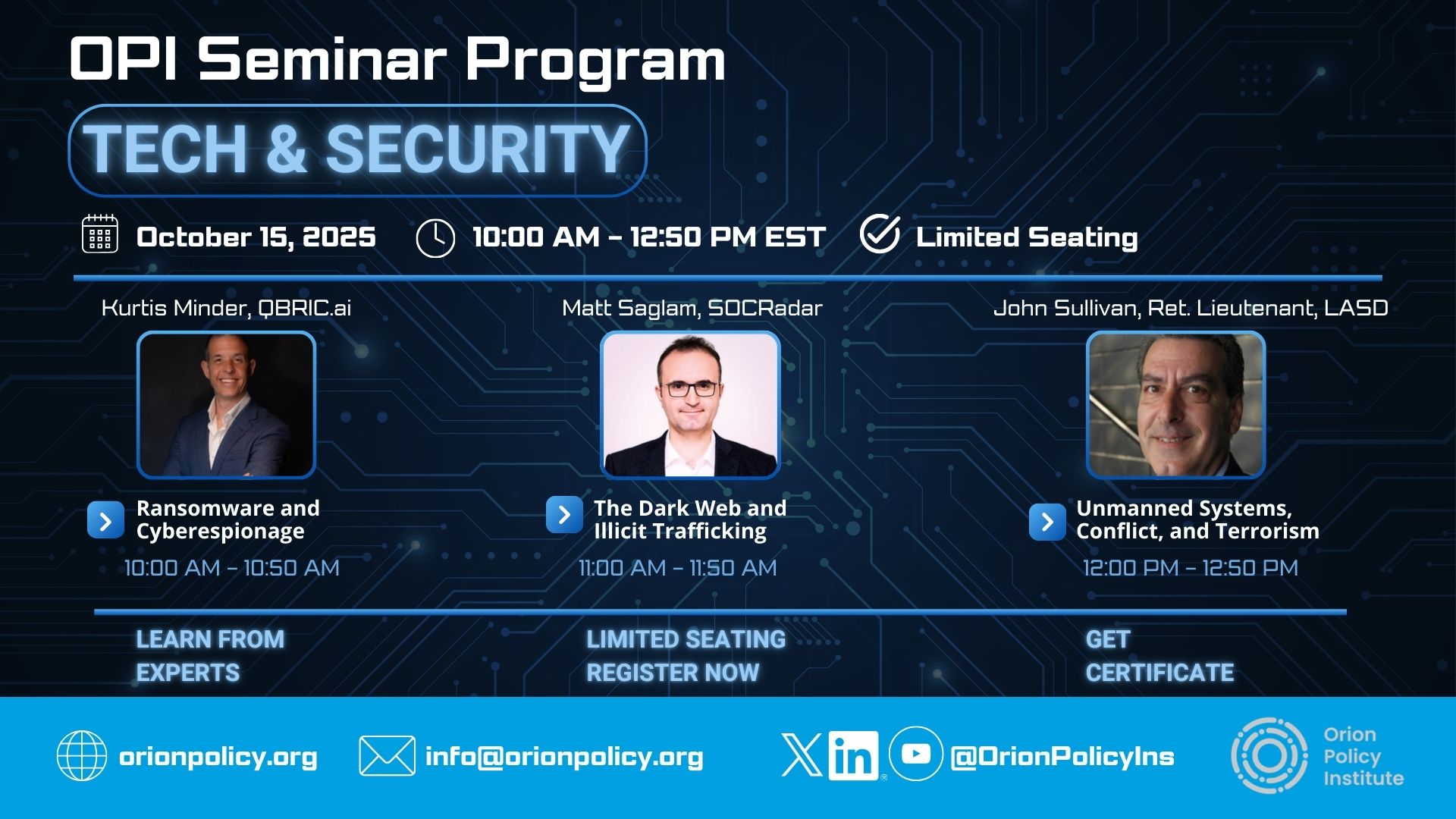
OPI Seminar Program on Tech & Security
Orion Policy Institute (OPI) hosted an online seminar program on Wednesday, October 15, 2025, between 10 am – 12:50 pm EST to discuss the latest

Orion Policy Institute (OPI) hosted an online seminar program on Wednesday, October 15, 2025, between 10 am – 12:50 pm EST to discuss the latest

ATM and POS skimming is a recurring societal problem, especially with the changing technological world. Recently, police discovered ATM skimming devices at convenience stores in

Many companies excitedly jumping on AI technology are making a classic mistake such that generative AI with LLM will automatically solve all their problems. Actually,

The past year stands out as one in which cyber adversaries have notably increased their operational capabilities. Cybersecurity in 2024 has been marked by the

A single breached password was used on the dark web to log in to a legacy VPN. Hackers reached servers, encrypted around 100 gigabytes of

Orion Policy Institute hosted a live webinar on the changing threat environment and challenges in cybersecurity.
The speakers included:
Dr. D. Kall Loper, Vice President of Digital Forensics and Incident Response at Herjavec Group/Fishtech Group
Mehmet F. Bastug, Assistant Professor at the University of Scranton

Download PDF Ransomware attacks have made headlines for years, but understanding the true impact requires significant resources and access to the confidential, inner workings of

Download PDF The return of the Taliban after the disastrous U.S. withdrawal from Afghanistan led to a torrent of post-mortems. But they often missed an important

While there have been numerous failed attempts to resolve the Kurdish issue in Turkey in the past, the Syrian conflict has added new dimensions and complexities to an already challenging matter. The political undertakings occasionally dubbed as “democratic openings” or “resolution processes” have ultimately faltered due to a multitude of political and social dynamics.

Many real-world crimes have long been replicated in cyberspace. Terrorism and extremism are no different. Today’s terrorist groups exploit the advantages the Internet has to offer. Just like everything else, crime, terrorism, violence, and even war have transformed into cyberspace: online radicalization becomes as significant as face-to-face radicalization, violent groups emerge on online platforms, and states use hacker groups to attack their enemies. In such a context, cyberterrorism is becoming a national security concern.