More than two years into the Sudan’s civil war, the power struggle between the Sudanese Armed Forces (SAF) and the Rapid Support Forces (RSF), a powerful paramilitary group, continues unabated. The conflict erupted in April 2023, when a long-standing rivalry between General Abdel Fattah al-Burhan of the SAF and Mohamed Hamdan “Hemedti” Dagalo of the RSF escalated into an open war in Khartoum. At the time, the dispute over the RSF’s integration into the national army quickly exploded into a nationwide conflict, collapsing state institutions and governance across the country.
The human cost of the war has been staggering. While the death toll varies according to different sources, hundreds of thousands have lost their lives, and more than 11 million have been displaced. This civil war, with more than 30 million people in urgent need of humanitarian assistance, has steadily become the world’s worst humanitarian crisis.
Meanwhile, mediation efforts have mostly been stalled due to the SAF and RSF’s refusal to abandon the violence and the fact that regional powers are aligned on opposing sides. While numerous nonprofit organizations, including Human Rights Watch, are accumulating evidence that mass atrocities have been committed during the conflict, the brunt of the fighting falls largely on women and children.
The Scale of the Crisis
Sudan’s civil war has unfolded into a disastrous crisis with shocking levels of destruction and intensity, yet it is largely ignored by the world. The brutal fighting between the SAF and the RSF represents a widespread disregard for civilian life and international humanitarian law. Civilians bear the brunt of the war, consistently facing widespread atrocities and attacks. The third year of conflict has seen rising civilian casualties as the parties launch indiscriminate attacks in densely populated areas that kill tens of thousands. Additionally, attacks on vital civilian infrastructure, like aid hubs, water systems, medical centers, schools, and fuel storage facilities are disrupting humanitarian operations and rendering civilians even more vulnerable.
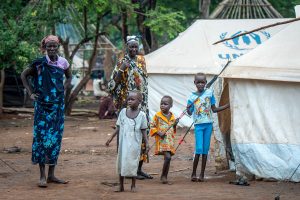
Sudan is now the largest and fastest displacement crisis in the world. The displaced face dire conditions in crammed camps with little access to food and water, where some people are left to sleep on the ground. Sudan is also facing extreme hunger, with half of the country’s population facing high levels of acute food insecurity.
The humanitarian crisis in Sudan has disproportionately impacted the lives of women and children. Women are exposed to staggering levels of gender-based violence that put over 12 million people, or 25% of the population, at risk. Furthermore, children make up over half of all those displaced. Women are the majority of caretakers, bearing the responsibility of providing for their suffering children while lacking access to food, water, and health care for their families.
Gendered Violence
As a UN Women official articulated, simply being a woman in Sudan “is a strong predictor” of hunger, violence, and death. The raging war has unleashed horrific sexual violence, with mounting evidence supporting that rape is systemically used as a weapon of war. A recent report by the UN Independent International Fact-Finding Mission for the Sudan documented that the RSF is committing sexual violence on a large scale in areas under their control, including gang rapes and multiple incidents of sexual slavery. Violence is so widespread that it is difficult for women and girls to feel safe anywhere. They face targeted attacks in their own homes, when fleeing violence, at checkpoints, and in refugee camps.
In addition to gender-based violence, women have been stripped of their livelihoods. With the collapse of businesses, restricted mobility, and financial losses, women who were once financially independent now face economic insecurity. This amplifies the unpaid care burdens that women already bear in providing for their families.
Access to health care services presents another challenge that disproportionately impacts women and girls. With nearly 80% of hospitals in conflict zones no longer functioning, women’s reproductive services are unavailable and maternal deaths are surging. Finally, Sudan’s children face an education crisis. With many schools still shut down, millions of school-aged children are out of education, upending the futures of these young boys and girls.
What the International Community Can Do
The world has not paid enough attention to the conflict so far. In addition to blocking the country’s path to genuine democratic transformation, the conflict also reflects a broader regional crisis. The war destabilizes Sudan’s neighbors and risks instability in the Sahel, along with the turbulent Horn of Africa and the broader Middle East. Therefore, ending the war in the country should be given a greater priority.
The international community should focus on ensuring that the warring parties lay down their weapons. The European Union (EU) has issued statements, imposed targeted, prolonged sanctions, and provided humanitarian efforts, but its response has been limited and insufficient. The EU’s efforts should go beyond issuing declarations and imposing targeted sanctions and take a more assertive diplomatic role. This means increasing pressure on states that financially and militarily support the conflict, as well as extending sanctions to include actors involved in arms transfers.
EU policymakers can also work with their African Union and Arab League counterparts to take a joint leadership role in pressuring regional sponsors in the conflict. A realistic strategy should acknowledge that some regional actors are arms suppliers to the RSF and actively fuel the conflict. These actors cannot be expected to serve as responsible parties in peacekeeping initiatives. Instead, the international community should work together to increase monitoring of illicit arms flows and to tighten and expand sanctions mechanisms.
For its part, the US can strengthen enforcement of multilateral sanctions, impose targeted pressure on regional governments that facilitate arms transfers, and expand support for UN mechanisms that document atrocities. Washington should also expand funding for humanitarian assistance and protective services for women and children, and work with partners to secure ceasefires and humanitarian corridors.
In this context, the voices of civil society actors and especially women’s groups are crucial in sustaining the possibility of peace. They should be resourced and protected. Their leverage in community trust is crucial for protecting civic space, documenting atrocities, and preparing the ground for eventual transition. Ultimately, sustainable peace efforts should also prioritize the meaningful participation of Sudanese women in post-peace processes, recognizing that a long-lasting solution is impossible without the leadership of those most affected by the war.
Orion Policy Institute (OPI) is an independent, non-profit, tax-exempt think tank focusing on a broad range of issues at the local, national, and global levels. OPI does not take institutional policy positions. Accordingly, all views, positions, and conclusions represented herein should be understood to be solely those of the author(s) and do not necessarily reflect the views of OPI.