



More than two months have passed since our last assessment on Airstrikes in the Caribbean, yet U.S. action against suspected Venezuelan narcotraffickers has accelerated, expanding in both scope and frequency. The situation has evolved into a sustained operation with far-reaching implications for U.S. policy and regional security.
What began as seemingly isolated maritime strikes is now a comprehensive campaign combining military force, financial sanctions, and formal terrorist designations. Under Operation Southern Spear, a formally named campaign under U.S. Southern Command, the United States has conducted more than twenty strikes across the Caribbean and Eastern Pacific, resulting in at least 80 fatalities, the destruction or destabilization of numerous vessels, and the deployment of significant U.S. military assets. Defense Secretary, Pete Hegseth, claims Operation Southern Spear “defends our Homeland, removes narco-terrorists from our Hemisphere, and secures our Homeland from the drugs that are killing our people.”
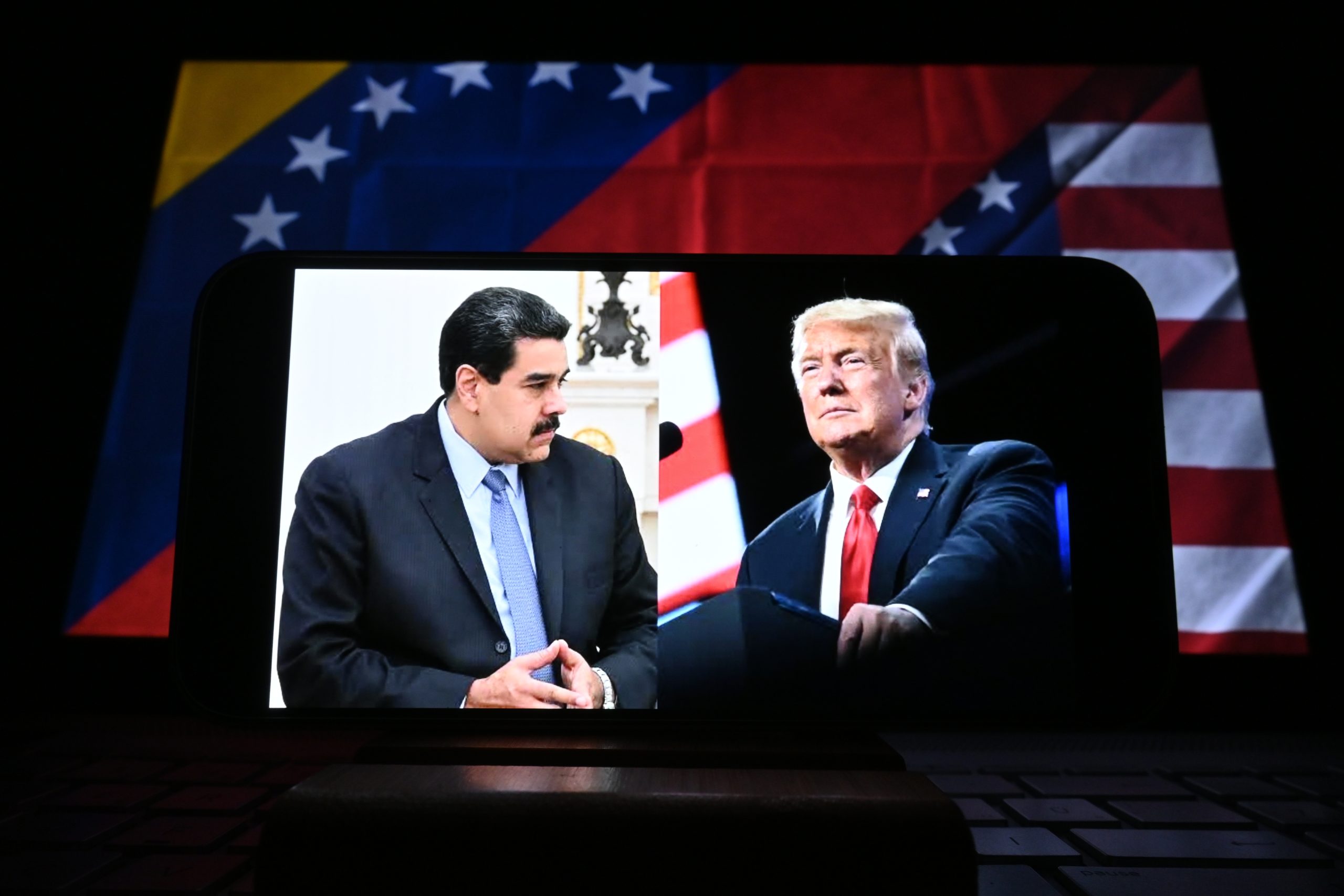
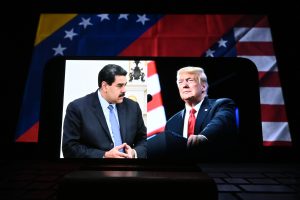
Against this backdrop, the U.S. government’s legal posture has hardened. On November 24, 2025, the U.S. Department of State formally designated Cartel de los Soles as a Foreign Terrorist Organization (FTO), changing their previous designation as a Specifically Designated Global Terrorist group. According to the Department of State, this Venezuela-based network, with links to illegitimate Venezuelan President Maduro, have corrupted Venezuela’s “military, intelligence, legislature, and judiciary”. This move marks the first time that a criminal, state-sponsored network directly tied to a standing foreign government has been designated as an FTO. This designation enables expanded targeting authorities, broader intelligence gathering and sharing abilities, increased financial sanctions, and a clearer path for the administration to justify military action against narcotraffickers as part of a counterterrorism campaign. This follows the earlier designation of Tren de Aragua (TdA) in February 2025, positioning both of Venezuela’s most powerful criminal networks within a counterterrorism framework. By framing Cartel de los Soles both as an FTO and as a criminal state network operating under the protection of the illegitimate Maduro regime, the United States has effectively linked Operation Southern Spear specifically to Maduro and not only non-state actors.
Since late November, the campaign has continued to evolve. On November 27th, President Trump announced that the U.S. would soon begin land-based operations against Venezuelan narcotraffickers, signaling a further expansion of the campaign. Under this new posture, Operation Southern Spear may evolve from a mostly maritime campaign into a broader counterterrorism operation, leading to major implications for U.S.-Venezuela relations. The December 3rd Treasury action adds a new economic dimension to an already complex situation. The most recent sanctions go beyond directly targeting these organizations and instead target money laundering networks that support such groups.
As the campaign continues to broaden in scope and complexity, this updated brief examines the evolution of the strike campaign since it began in September, incorporates newly reported information and official statements, and reassesses the strategic impact of using lethal military force against non-state trafficking networks outside a formal conflict zone.
U.S. Counternarcotics Policy and the Post-9/11 Shift
As detailed in the previous article, U.S. counternarcotics policy has passed through multiple stages, from criminalization in the early-19th century to the later public health approaches during the opioid crisis. Since 9/11, counternarcotics has increasingly merged with counterterrorism operations, especially in Afghanistan. As outlined previously, this trend sets the stage for the continuing escalation: the application of counterterrorism authorities to criminal networks, the integration of military force in counter-narcotic operations, and now, the unprecedented use of sustained airstrikes and the possibility of land operations against drug traffickers, especially those with direct ties to the government of Venezuela.
Operation Southern Spear: Evolution and Escalation
Although Operation Southern Spear was first announced in January 2025, aiming to “operationalize a heterogeneous mix of Robotic and Autonomous Systems (RAS) to support the detection and monitoring of illicit trafficking”, it initially drew little public or policy attention. At the time, it was described as a broad, low-visibility framework for strengthening U.S. efforts to “provide coordinated maritime domain awareness and conduct counternarcotics operations”. However, the significance of the operation truly emerged in November 2025 when the Pentagon re-announced Operation Southern Spear. This second announcement coincided with an expanded regional force posture, the continued escalation of maritime airstrikes, and the integration of counterterrorism authorities, effectively marking the true operational launch of the campaign.
In the wake of these announcements, U.S. operations entered a period of rapid expansion, as both strike activity and the regional force posture increased sharply.
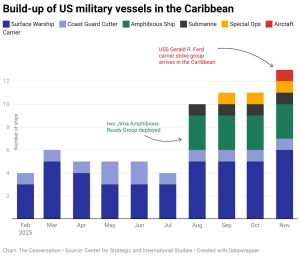
The operational profile of Operation Southern Spear changed drastically between September and December 2025 as U.S. maritime strikes accelerated in combination with a major surge in military assets across the Caribbean and Eastern Pacific. At the same time, the U.S.G began using financial sanctions to target not only trafficking networks directly but also the broader support networks sustaining narcoterrorist operations. In the latest such action, on December 3, 2025, the Treasury Department sanctioned a network of individuals and entities connected to Tran de Aragua’s money laundering and logistics operations, including a Venezuelan entertainer alleged to have provided material support to TdA. These sanctions freeze U.S.-based assets, block access to U.S. financial systems, and prohibit transactions involving U.S. persons.
The integrated use of military force, new terrorism authorities (expanded legal powers enabling U.S. agencies to target individuals, networks, and infrastructure linked to designated terrorist or terrorist-affiliated groups), and financial disruption provides evidence that the U.S. is no longer solely targeting vessels or individual shipments but is aiming to dismantle entire transnational criminal networks by attacking them from multiple avenues.
What began as isolated attacks quickly evolved into an operation supported by carrier aviation and Marine expeditionary forces.
Initial operations were concentrated in the southern Caribbean where U.S. airstrikes targeted suspected narcotrafficking vessels. Attacks took place off the coast of Venezuela; near Trinidad and Tobago; along the Aruba-Curaçao corridor; and against at least one submersible vessel. These engagements targeted vessels allegedly linked to Tren de Aragua and other hybrid trafficking networks. As pressure intensified in the Caribbean, trafficking networks shifted routes westward. U.S. strikes followed, attacking vessels off the coasts of Colombia, Ecuador, and Peru.
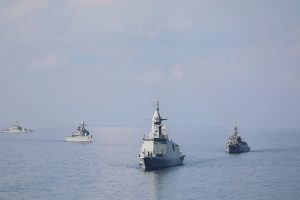
These strikes form part of a rapid expansion of U.S. force presence in the region, one of the largest deployments to the Caribbean in decades. The buildup includes the 22nd Marine Expeditionary Unit, adding more than 2,200 marines, MV-22 Ospreys, CH-53E helicopters, and landing craft. Roughly 10,000 troops, at least eight naval warships, two B-52 aircraft, and MQ-9 Reaper drones have also been deployed recently. Ten F-35s were deployed to Puerto Rico in September and an estimated 150 special operations troops are conducting missions from MV Ocean Trader. However, Trump’s latest announcement of a planned land-based operations would require at least 50,000 troops. As of November 26th, there have been additional troop and aircraft deployments across the Caribbean, with an estimated 15,000 troops now in the region.
Regional partners played a significant role in the buildup. For example, the president of the Dominican Republic has authorized the U.S. government to operate within restricted areas of the Caribbean, refueling aircraft and transporting equipment through otherwise restricted areas to help its fight against drug trafficking.
Target Networks: From Cartels to State-Supported Networks
Tren de Aragua (TdA)
Designated as an FTO in February 2025, TdA is Venezuela’s most powerful homegrown criminal actor and the only Venezuelan gang that operates outside of Venezuela in Colombia, Peru, and Chile. Its role in regional violence and trafficking has positioned it as a primary target.
Cartel de los Soles
Designated as an FTO on November 24, 2025, this group is headed by Nicolas Maduro and explicitly tied to other high-ranking individuals. Cartel de los Soles dates back to the early 1990s when investigators first targeted two senior officers of the Venezuelan National Guard for alleged drug trafficking and related crimes. Various allegations related to Cartel de los Soles and connected senior officials continued through 2020 when the U.S. Department of Justice indicted Maduro and other senior officials on narcoterrorism charges, accusing them of corrupting state institutions and trafficking of cocaine to the U.S. The indictment stated that Maduro and other officials “abused the Venezuelan people and corrupted the legitimate institutions of Venezuela— including parts of the military, intelligence apparatus, legislature, and the judiciary— to facilitate the importation of tons of cocaine into the United States”. At the time, the U.S. Department of States was offering an award of $15 million for information leading to Maduro’s arrest and in August 2025 that reward was raised to $50 million.
For the United States, the significance lies in the fact that Cartel de los Soles represents not merely organized crime, but a state-linked network operating under presidential protection using, making its activities relevant to counterterrorism authorities now driving Operation Southern Spear.
Regional and Non-Venezuelan Actors
Operation Southern Spear has also reportedly targeted multi-national crews and smuggling cells linked to Colombian and broader trafficking networks, expanding the campaign beyond Venezuela alone.
Legal and Scholarly Debate
The administration’s legal justification for Operation Southern Spear rests on the argument that the United States is engaged in armed conflict with narcoterrorist organizations, an interpretation strengthened by official FTO designations. Under this view, these groups constitute unlawful enemy combatants operating from Venezuelan territory with state protection, thereby allowing the U.S. to use tactics similar to those used during wartimes under Article II and counterterrorism statutes.
This framework has nevertheless generated significant debate among legal scholars and terrorism experts. Critics argue that most cartels lack the ideological or political goals of typical terrorist organizations and warn that stretching the definition of terrorism to include profit-driven criminal networks risks eroding long-standing legal distinctions between crime and armed conflict. However, others argue that these criminal organizations do in fact pursue political goals as an organization.
Supporters of the administration’s approach counter that the scale of violence, territorial control, corruption, and transnational operations exhibited by groups like TdA and Cartel de los Soles increasingly resembles the behavior of non-ideological terrorist groups in other regions, making traditional law-enforcement tools insufficient. Designating an organization as an FTO increases sanctions and effectively ejects the group from the U.S. financial system.
The addition of Treasury sanctions introduces economic warfare into an already-complex environment, one that also further complicates previous debates. On the one hand, targeting the financial and logistical backbone of designated FTO’s arguably strengthens legal justification under existing counterterrorism authorities, providing non-military tactics to combat illicit operations without resorting to force. On the other hand, broadening sanctions to include associated civilian actors raises concerns among legal scholars and analysts that financial pressures blur the line between criminal due process and punitive collection measures.
Critics further warn that conflating narcotics trafficking, financial crimes, and terrorism exposes innocent third parties to targeting that is too broad. Yet, supporters argue that the scale, sophistication, and state-protected nature of these networks warrant a comprehensive approach.
Considering both sides of the debate there is clearly tension in U.S. policy: whether the evolving nature of hybrid criminal-state networks justifies expanding the legal boundaries of counterterrorism or whether such expansion risks destabilizing the very legal framework that governs the use of force.
Strategic and Regional Implications
Operation Southern Spear has produced notable short-term tactical successes, including the disruption of trafficking in the Caribbean and Eastern Pacific and the destruction of maritime assets used by trafficking networks tied to Tren de Aragua and Cartel de los Soles. These actions demonstrate U.S. commitment to disrupting and eradicating drug trafficking through these routes and have temporarily constrained certain smuggling corridors.
The addition of financial sanctions to the U.S. campaign amplifies its potential impact. By targeting money-laundering networks and other logistical groups supporting TdA and Cartel de los Soles, the U.S. enhances long-term disruption capacity beyond the immediate impact of airstrikes. However, this does not happen without its own associated risks. Combining military force with sanctions could deepen perceptions of U.S. hostility among Venezuelan and regional actors, raising the risk of retaliatory measures.
While the combination of military force and broad sanction may prove beneficial to the overall campaign, the strategic picture is much more complex. Trafficking organizations are highly adaptive and are likely already shifting to alternate routes, smaller vessels, or to land-based operations, a shift that U.S. officials themselves cite as justification for potential ground operations. While the recent attacks have found some success, there exists ample controversy surrounding the alleged “double tap” strikes and the prospect of U.S land operations which increase the risk of civilian harm, legal scrutiny, and reputational concerns.
Policy Options
Despite the updates, the path forward remains consistent. For airstrikes to remain successful, they must be combined with increased interruptions of trafficking through land and air routes as well, which is something the Trump administration seems to be progressing towards. In addition, the new Treasury sanctions push for a broader economic impact. An integrated multilateral strategy that combines airstrikes with financial sanctions, disruption of air and land routes, continued seizure of large shipments of drugs, and continued targeting of the trafficking networks may prove a more permanent solution. This approach balances tactical disruption with other broader, more comprehensive approaches to combating this crisis.
Risk Assessment
The integration of financial sanctions increases both opportunities and risks. While sanctions reduce reliance on military force and may degrade cartel and trafficker capacity, they also risk overreach, civilian collateral damage, and regional economic destabilization, particularly if sanctions catch non-combatant actors or affect legitimate commerce. Combined with potential land operations, these pressures raise the stakes for oversight and long-term strategic sustainability.
Conclusion
Operation Southern Spear has evolved quickly from seemingly isolated attacks targeting narcotraffickers in the Caribbean to a militarized counterterrorism campaign aimed at multiple narcoterrorist networks with the addition of new financial sanctions. It is clear the U.S. is no longer simply looking to disrupt trafficking in the Caribbean and Eastern Pacific but are confronting state-embedded criminal networks on a much larger scale.
While the potential for success at disrupting and confronting criminal networks has increased, so have the legal, political, and humanitarian risks. Without rigorous oversight and transparency, the campaign risks weakening U.S. credibility and further destabilization of regional security which could lead to dangerous precedents for future militarized counternarcotics interventions.