The Trump administration’s recent designation of the Clan del Golfo Colombian armed group as a foreign terrorist organization marks a significant escalation in the Trump administration’s counter-narcotics policy in Latin America. Secretary of State Marco Rubio announced on December 16th that the Colombian group would join a growing list of purported terror organizations in the hemisphere including Venezuela’s Tren de Aragua gang.
The Clan del Golfo is among Colombia’s largest and most powerful armed groups with an estimated 3000 fighters and several thousand civilian supporters, the organization is a major player in the country’s cocaine trade. Its designation as a terrorist organization is emblematic of the administration’s rationale for an organized crime-terrorism nexus and is likely aimed at providing a policy justification for future strikes against suspected traffickers.
From Guerrillas to Narcoparamilitaries
Self-described as the Autodefensas Gaitanistas de Colombia (Gaitanista Self-Defense Forces of Colombia or AGC), the group has been labelled the Clan del Golfo by Colombian authorities after the Caribbean Urabá Gulf. Much of the group’s leadership traces back to the Marxist Ejército Popular de Liberación (EPL) guerrilla which was forcibly assimilated into the right-wing paramilitary Autodefensas Unidas de Colombia (AUC) during the 1990s. In the wake of the AUC’s 2006 demobilization, members of what are now the AGC refused to disarm and instead pivoted to expanding control over illicit economies.
The Clan del Golfo retains the paramilitary organizational structure of its predecessors with most of its leaders having previously served in both the AUC and EPL. The group itself is composed of regional blocs each of which is subdivided into mobile fronts and columns ranging from a few dozen to as many as one hundred fighters. The Clan del Golfo is active in around one third of Colombia’s municipalities, largely throughout the Caribbean, Pacific and central Amazon. Graffitis with the letters AGC are a common staple of rural towns where the group acts as a parallel government.
Its chief competitors are the Ejército de Liberación Nacional (ELN) and FARC dissident guerrillas, both of which were designated as terrorist groups in previous decades. Together, the three actors are the prime movers of Colombia’s armed conflict, exacting illicit rents from a wide portfolio including human trafficking, illegal mining and coca cultivation.
A Decentralized Criminal Empire
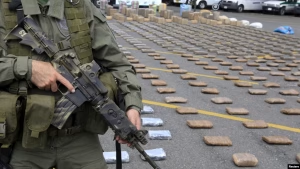
Like its guerrilla competitors, the Clan del Golfo makes ample use of outsourcing. In the case of the cocaine trade, a series of tollbooths are paid to the organization along each node of production. Coca farmers in the southern Pacific, Bajo Cauca and Catatumbo regions provide the raw paste that is later processed into finished cocaine by traffickers. These traffickers proceed to traffic the drug by land and/or maritime routes controlled by the Clan del Golfo, most notably throughout the Panamanian as well as parts of the Ecuadorian and Venezuelan borders.
In many though not all cases, the group engages in direct trafficking at both the local and international level. Following the end of the Covid-19 pandemic, the Clan del Golfo charged hundreds of thousands of migrants for passage through the perilous Darien Gap. Coyotes I spoke with in 2021 and 2022 explained that the group reserved specific routes for trafficking cocaine while migrants toiled for days at a time through the jungle; similar preference was given for maritime routes throughout the Panamanian isthmus.
The Clan del Golfo conducts routine attacks against Colombian security forces and infrastructure and has been known to recruit minors into its ranks. In 2022, the group announced a national “armed strike” paralyzing dozens of towns throughout the Caribbean following the extradition of its leader, Dairo Antonio Usuga, alias “Otoniel,” to the United States.
Legal and Strategic Implications
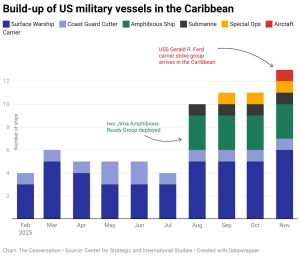
The Clan del Golfo’s designation as a Foreign Terrorist Organization carries significant legal implications. Providing material support to the organization is now a federal crime in the United States and triggers harsh financial sanctions. Foreign banks and front companies that provide services to the organization could face serious consequences. More consequentially, however, the designation is likely aimed at providing a legal framework for kinetic action against the group at a time when recent strikes have come under congressional scrutiny.
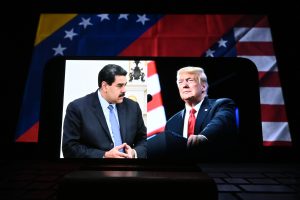
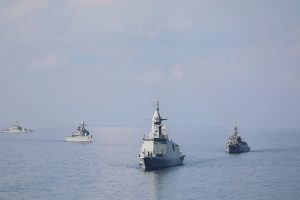
It’s plausible that some of the victims of Caribbean strikes were members of or were contracted by the Clan del Golfo. Having designated the Venezuelan Tren de Aragua gang and so-called Cartel of the Suns as terrorist organizations in February, the administration previously claimed that strikes near Colombia were aimed at the ELN. Though the ultimate legality of kinetic action against traffickers remains in question, the Clan del Golfo’s designation as a terror group is likely aimed at grounding future–and possibly retroactive–strikes within a counterterrorism framework.
Future Prospects
The Clan del Golfo has been engaged in peace talks with the Colombian government since September. The Petro administration has promoted a policy of “Total Peace” with armed groups aimed at securing terms of peace and/or surrender in exchange for reduced sentences. Earlier this month, the Colombian government and Clan del Golfo signed an agreement in Qatar establishing special zones where fighters could gather beginning in March of 2026 to further talks.
Most analysts are skeptical that the group is negotiating in good faith, noting the competing interests of its members; many Clan del Golfo fronts are unlikely to relinquish control over illicit economies. Crucially, moreover, the Qatar agreement stipulates that Colombia would suspend extraditions of AGC leaders to the United States during negotiations. Despite ongoing tensions between Bogotá and Washington, the Petro administration has continued to cooperate with extradition orders from the US. The terrorist designation could be interpreted as a message to Petro that his government should continue cooperating with Washington.
By treating major trafficking organizations as terrorist groups, the Trump administration is expanding the War on Drugs in ways that previous administrations avoided. Whether this approach proves more effective than traditional law enforcement remains to be seen.
*image credit: VOA.
Orion Policy Institute (OPI) is an independent, non-profit, tax-exempt think tank focusing on a broad range of issues at the local, national, and global levels. OPI does not take institutional policy positions. Accordingly, all views, positions, and conclusions represented herein should be understood to be solely those of the author(s) and do not necessarily reflect the views of OPI.